
Hot Tent Cooking

We often get asked, “Can you cook in a hot tent?” We do, all the time! The next question is “Do you worry about getting critters in your tent?” The short answer is no, we don’t, because we are thoughtful about cooking and food storage depending on the season, as well as the hibernation and migration habits of the creatures we may encounter in the woods. Since we winter camp in the northern parts of the upper midwest, the most common animal we worry about invading our campsite are black bears, who are denned up in the winter. We have camped many times in coyote and wolf country, and other than being sung to in the night, we have never had an issue with them encroaching on our camp. However, when we go out west, or camp in the summer, we obviously use all the best practices to keep bears and other large animals out of our camp. It is always a good idea at any time of the year to keep in mind what animals are out and about in your particular area that might be interested in food when you are camping. However, for the purposes of this blog post, we are assuming that the creatures you would rather not have in camp, like bears, are tucked in for their long winter nap.
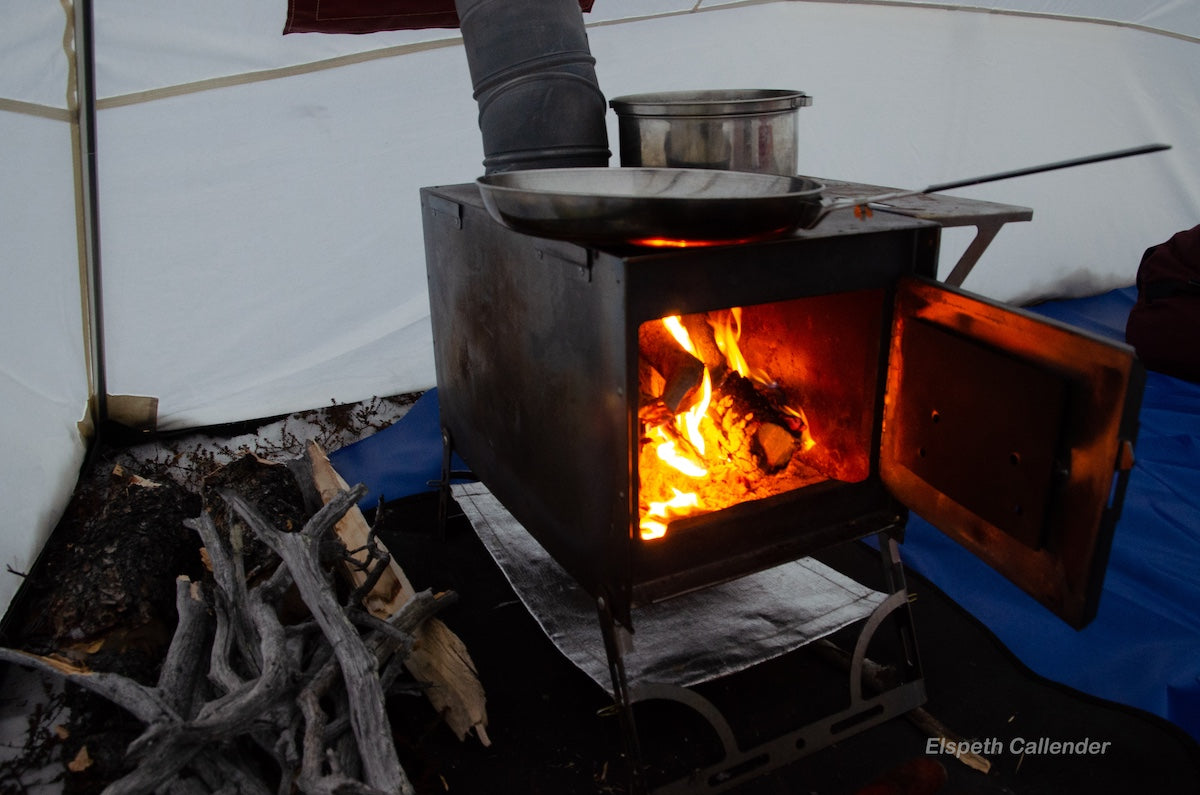
If you are new to hot tent camp cooking, the hardest thing to master when cooking on a tent stove is temperature control. Often the temperature you need for the meal you are cooking and the temperature you need for comfort in the tent are not the same. Unless you are out in shoulder seasons, when you might have small fires (low heat), your stove will generally need to run hotter than you want for most cooking, because the stove’s main job is to heat your tent. If you are searing or sautéing something, high heat’s not usually a problem; it’s what you want. But what if you are simmering a stew or something that needs a little less heat? There are tricks that can help reduce the heat reaching your pots and pans. One of the easiest ways to lower the heat to your cooking pan while still keeping the stove hot enough to keep the tent warm is by having a metal trivet (or three canning jar rings set in a triangle formation) on your stove and balancing your cook pan on top. This creates an air gap between the top of the stove and the bottom of your pan, giving you cooler temperatures for simmering or warming food up. You may also simply be able to move your pots and pans around the stove top, as different areas on the surface can often have different temperatures. Like with many things, practice helps, and cooking on a wood stove is an easy thing to get good at quickly once you realize that instead of turning your heat source up and down, you manage cooking by keeping consistent heat and controlling how much of that heat reaches your pan.
Once you have gotten the hang of cooking in your tent, you may start to wonder how to make really good meals without spending all day cooking or resorting exclusively to freeze-dried options. Obviously, once you get to camp and get set up, you don’t want to spend the next 5 hours making your meal. One option is to try to cook like a restaurant does. The reason many restaurants are able to serve so many people in a comparatively short amount of time day after day is due to all of the prep work that happens before you arrive. The principle behind prepping, and how we approach cooking in camp, is to prepare as much as possible ahead of time, so that once you are in camp, all you are doing is finishing your meal, not starting from scratch. Bacon, for example, can be cooked 90% of the way to where you like to eat it at home, and then quickly finished in a few minutes for your morning breakfast Soups and stews can also be prepared ahead of time so all that is needed is a quick reheat, not hours of simmering on the stove. The only thing we don’t prepare ahead of time are items that are quick to prepare and better done in the moment. Think: steaks, vegetables, pancakes, French toast or eggs.
For example, I love a good homemade corned beef hash for breakfast, but I don’t want to have to bring a can of premade hash along, or I don’t want to spend half the morning cooking, either. So how do I make a breakfast hash in 20 minutes or less? Preparation! By prepping food at home, all I need to do is fry it up in a hot pan in camp and cook some over easy eggs for it. Prep at home is pretty simple: I precook the potatoes and corned beef, dice peppers and onions, mix them all together in a gallon plastic bag, and store in the fridge until my trip. What I am not doing is starting my morning in the tent peeling and dicing potatoes, chopping onions and peppers and cutting up corned beef, since all of that has been done and portioned out ahead of time. Once the pan is hot, all I need to do is get the hash hot and crispy and enjoy. This idea can be translated to many different meals. Pasta can be precooked so all I need to do is quickly warm it up in its sauce. If I want chicken quesadillas, I precook and shred chicken, mix it with cheese and fill my shells. So all I have to do when I get to camp is fire up the stove and finish cooking them. Prepping your meals allows you to make delicious fresh food without spending hours cooking for every meal or resorting to freeze dried pre-packaged meals. Because the temperature outside is cold when winter camping, you are able to bring fresh food on trips and worry less about food spoiling in the heat. I actually use coolers in the winter to help keep food from freezing in the cold. The insulation in a cooler does a pretty good job of keeping food from freezing on you.
This is a different style of cooking for many people, especially if you have not spent time in the heat of a busy kitchen during dinner rush. It is not, however, impossible to learn; think of it as just another piece of your gear prep, and a great way to take advantage of the fact that it’s colder outside your tent than it is on the inside of your refrigerator. Look at your menu for your trip, and consider what you can prepare ahead of time without sacrificing quality. Can you cook your bacon 90% of the way and just crisp it in the morning? Chances are you can. Can you precook a steak? Yes, you can, but I would argue that you shouldn’t. It is much better cooked directly before eating it. Need recipes or inspiration? There is a wealth of information on the internet and many cookbooks about camp cooking, and they can be an invaluable source of knowledge, tips, and tricks of camp cooking.
Cooking this way might not be as quick as boiling water for a freeze dried meal, but it is definitely much tastier and pretty efficient. We don’t always prioritize efficiency–if we have days spent in camp and are not on the move, we may start a stew from scratch and simmer it for hours. These are also good days to dig out the reflector oven, if you have one, and do a little baking.
To wrap it all up, when camping in the winter, we just don’t worry about cooking in our tents, because we keep informed about what wildlife and weather we can expect in the area and prepare our food and food storage appropriately. The best approach we can recommend is to be smart, do your research for the area and season you are camping in, and if you are camping in an established park, they will have guidelines for food storage and park staff to offer advice. Always trust the locals with knowledge of the area you are camping in, especially in regards to what wildlife you need to be concerned with. And approach camp cooking with a bit of planning. A little prep work ahead of time allows you to make delicious meals in your tent with very little effort, and you will reduce the amount of time you are cooking, increase the quality and diversity of your meals, and you may just become the most important person on any trip…the camp Chef!